The Most Common Cancer We Face—and the People Who Can Help Catch It Early
Skin cancer remains the most common cancer in the United States, with millions of new cases diagnosed each year. Yet signs are missed far too often because many people do not get routine skin checks, and early changes can be subtle. That delay can change everything.
There is a powerful and often overlooked group that can help: personal care professionals. Hairdressers, barbers, nail technicians, massage therapists, tattoo artists and others see their clients up close and long before most people visit a doctor. They notice areas most people never see on themselves—the scalp, the back of the neck, behind the ears, shoulders and even the fingernail beds.
I often say, “Personal care professionals should also be on the lookout and let their clients know if they see something. Skin cancer often starts out as a small discoloration, lesion or wart that should be seen by a doctor.”
This work is centered on one essential idea: bridging the gap between community observation and clinical action. When someone notices a change and speaks up, they help make early medical care possible. That simple act can save a life.
How Skin Cancer Appears on Black and Brown Skin
A key message we emphasize is that skin cancer can show up differently depending on skin tone. In the African American community, early signs may appear in less expected places, including:
Palms of the hands
Soles of the feet
Under the fingernails and toenails
Nail beds
Scalp
Behind the ears
Areas not typically exposed to the sun
These spots can look like small patches of discoloration, a dark line under a nail or a mark that resembles a bruise or wart. Because people often do not expect skin cancer in these places, changes may be overlooked or dismissed. And because fewer Black Americans receive routine skin checks, cancers are frequently diagnosed at later stages.
This is why paying close attention matters. When a barber notices a new spot on a client’s scalp or a nail technician sees a change under a nail, that moment can prompt someone to seek the care they need.
A Community Workshop on Early Detection
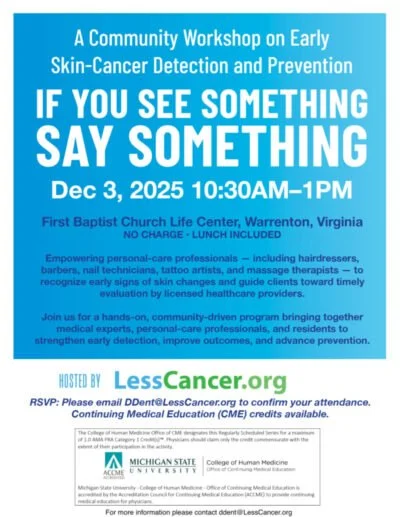
To support this effort, Less Cancer is hosting a free Early Skin Cancer Detection and Prevention Workshop, When You See Something, Say Something, on Wednesday, December 3, from 10:30 a.m. to 1 p.m. at First Baptist Church in Warrenton, Virginia. Lunch is provided.
The workshop is designed for personal care professionals but open to everyone. We will share what to look for, where to check and how to encourage clients, friends or family to speak with a healthcare provider when something looks different.
To reserve a spot, visit: eventbrite.com/e/if-you…
When we connect what the community notices with what clinicians can treat, we save lives. Early detection begins with people paying attention—and looking out for one another.