A Place at the Table
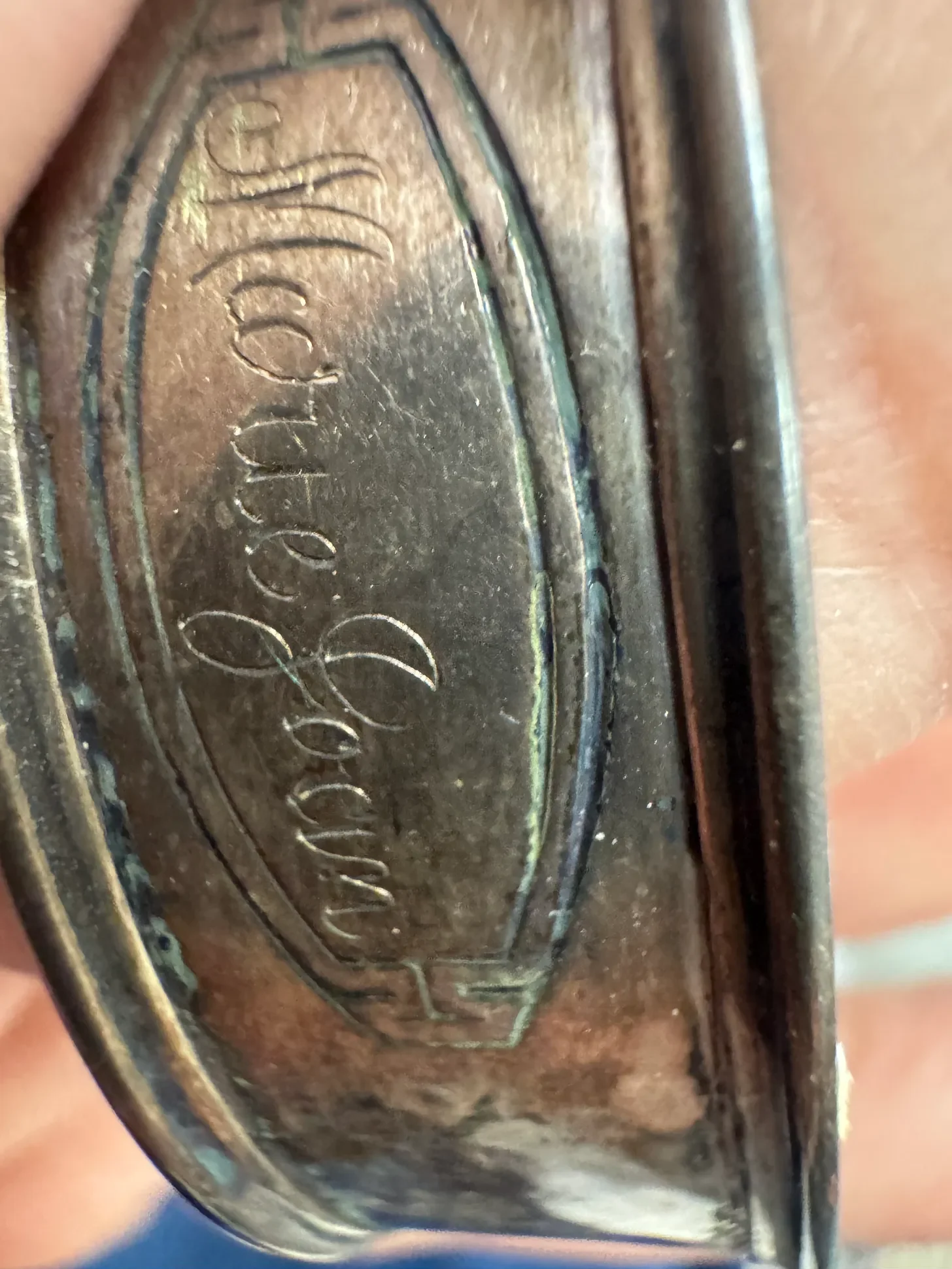
Yesterday, I was going through old boxes and came across a few small things that stopped me in my tracks: old photographs, documents, my mother’s baby bracelet, and a small silver napkin ring with her name engraved on it. They were tucked together — likely a baby gift, given at the same moment.
On January 4, that baby bracelet and napkin ring will be 100 years old.
This baby gift of a napkin rang 100 years ago, was symbolic of having a place at the table
What a different time it was. A century ago, welcoming a baby into the world came with enormous uncertainty. Infant and childhood mortality were common. Many babies simply did not make it.
And yet, even then, families marked a child’s arrival with something that symbolized belonging. Baby napkin rings weren’t just decorative keepsakes — they were meant to say you have a place at the table. Not someday. Now.
Over the next hundred years, so much changed. Because of vaccines, modern medicine, and public health, children born in recent decades were given something earlier generations could barely imagine — a far more hopeful future. For a long time, a place at the table was no longer a fragile hope; it was close to a given.
Or at least, it was.
As I kept sorting through boxes, I found photographs of my own children when they were small — that fleeting, joyful time when everything feels possible and the world still seems mostly safe. It made me smile. And then it made me deeply sad.
Because this is a very hard moment to be a new parent.
Families today aren’t just worried about affording Christmas. They’re worried about affording health care. They’re trying to hold together traditions and create normalcy for their children while quietly carrying fear about how they’ll care for their families in the months ahead. How do you schedule a doctor’s appointment when you don’t have insurance? How do you afford one when coverage is out of reach? How do you choose between food on the table and medical care? These are not abstract policy debates — they are daily calculations happening in millions of households.
At the same time, science and medicine — the very tools that once reassured parents — are being undermined by politics, chaos, and a loud, entitled few who have worked for decades to roll back progress. This isn’t accidental. Many of those creating confusion and distrust have personally profited from doing so, financially or politically. Confusion is not a byproduct for them; it is the business model. And the people paying the price are not the ones creating the chaos.
Wellness, in many forms, can be helpful. Movement, nutrition, mindfulness — all of that has value. But wellness does not replace science. The modern wellness industry is a massive, largely unregulated, multi-billion-dollar enterprise. Unlike medicine and vaccines, it is not held to consistent standards of evidence, oversight, or accountability. Confusing wellness culture with medical science leaves families vulnerable — especially when real disease shows up.
Recently, I found myself in a public space filled with young children. It should have felt ordinary. Instead, I felt a knot of anxiety. I caught myself wondering who was vaccinated and who wasn’t — not out of judgment, but out of concern. Unvaccinated children don’t exist in isolation. They are part of communities, and the diseases they can unknowingly carry don’t stop at the playground door.
I thought about older adults like me, people with underlying health conditions, grandparents, cancer patients, and newborns — all navigating RSV, COVID, flu, and pneumonia at once. And it’s important to say this clearly: the children aren’t the problem. They never are. The harm comes from misinformation and from systems that fail to protect people when they are most vulnerable.
A place at the table means more than being welcomed. It means being protected. It means building systems that don’t force families to choose between survival and care, that don’t turn public health into a political weapon, and that don’t quietly decide who belongs and who does not.
I’ll keep banging the drum, even when people are tired and worn down — and I understand why so many are. That exhaustion didn’t happen by accident. Still, stepping away only makes it easier for families to be left behind.
To the young parents carrying this quietly right now: I want you to know I’m pulling for you, and I’m worried about you.
If a simple silver napkin ring could once symbolize belonging and care, surely we can do better now. Making room at the table means safeguarding health care, honoring science, and choosing to look out for one another — especially the youngest, the oldest, and the most vulnerable among us.
Everyone deserves a place at the table. And I still believe we can choose to keep it set.
Bill Couzens is the founder of Less Cancer and a longtime advocate for cancer prevention, public health, and evidence-based medicine.