
THE VALUE OF TRUST
I've been thinking out loud lately about trust.
Part of that comes from watching communities across the country consider large development projects and the philanthropy that often accompanies them. Companies support nonprofits, schools, community groups, and local initiatives. Sometimes that support is simply generosity. Sometimes it raises questions.
I'm not writing this to criticize any particular company, project, industry, or nonprofit. In fact, I don't know enough about many situations to offer a fair judgment.
What I do know is how we approached these questions at Less Cancer.
I began organizing what would become Less Cancer before it officially launched in 2004. Looking back, I don't remember a straight line.
I remember uncertainty.
I remember trying things that didn't work.
I remember changing course.
I remember board discussions, disagreements, second guesses, and lessons learned.
Like most organizations that survive for more than twenty years, Less Cancer wasn't built through perfection. It was built through a willingness to learn, adapt, and keep moving forward.
Many of the policies and boundaries we have today didn't appear fully formed. They evolved over time as we encountered new opportunities, new challenges, and new questions.
What remained consistent was the belief that trust was worth protecting.
One reason we felt compelled to establish clear boundaries was the nature of our work. Much of what we do sits at the intersection of education, prevention, public health, scholarships, policy discussions, and professional education.
Because of that, we felt we needed to be especially careful about conflicts of interest and perceived conflicts of interest.
Not because we're better than anyone else.
Not because we've never made mistakes.
But because trust matters.
Over the years, people suggested sponsorships, product partnerships, wellness campaigns, supplements, vitamins, energy bars, and countless other opportunities.
That wasn't really the point.
We never wanted Less Cancer to become a platform for product endorsements. We didn't want people wondering whether a message was supported by evidence or supported by a sponsor.
Instead, we chose to focus on education, prevention, and helping people ask better questions.
That approach isn't right for every organization.
Many organizations do extraordinary work using models that look different from ours. We collaborate with many of them.
Collaboration is not endorsement.
Partnership is not agreement on every issue.
Respect does not require uniformity.
Cancer prevention, public health, environmental health, and access to care are too important and too complex for any one organization to tackle alone.
We've participated in public health and cancer prevention research efforts over the years, not because we're the laboratory or the lead scientific institution, but because we've often helped connect people, communicate findings, convene conversations, and build partnerships.
That role depends on credibility.
Maybe that's why I still struggle with some of the questions surrounding philanthropy and influence.
I understand why organizations accept certain funding relationships. Running a nonprofit is difficult. Raising money is difficult. Serving communities is difficult.
But I also think we've become too comfortable pretending that money never influences the conversation.
Sometimes it does.
Not through secret agreements.
Not through explicit demands.
Through relationships.
Through gratitude.
Through access.
Through the natural human tendency to avoid challenging the people who help support our work.
That doesn't mean anyone has done anything wrong.
It simply means we should be willing to ask the question.
When a company provides significant support throughout a community, will organizations still feel comfortable asking difficult questions if concerns arise later?
Maybe the answer is yes.
I hope it is.
One thing I've learned over the years is that financial size is often confused with success.
I've never viewed it that way.
In fact, some of the decisions that limited our growth are the very decisions that make me most proud.
Would additional resources have allowed us to do more? Absolutely.
But growth has never been our only measure of success.
Trust matters.
I should also be clear about something.
These reflections are my own. Less Cancer is governed by a Board of Directors, not by me alone.
Over the years, our policies, governance practices, financial oversight, and organizational standards have been shaped by board members, advisors, attorneys, accountants, physicians, researchers, community leaders, and volunteers who have devoted their time and expertise to helping the organization stay true to its mission.
What I've come to believe is simple:
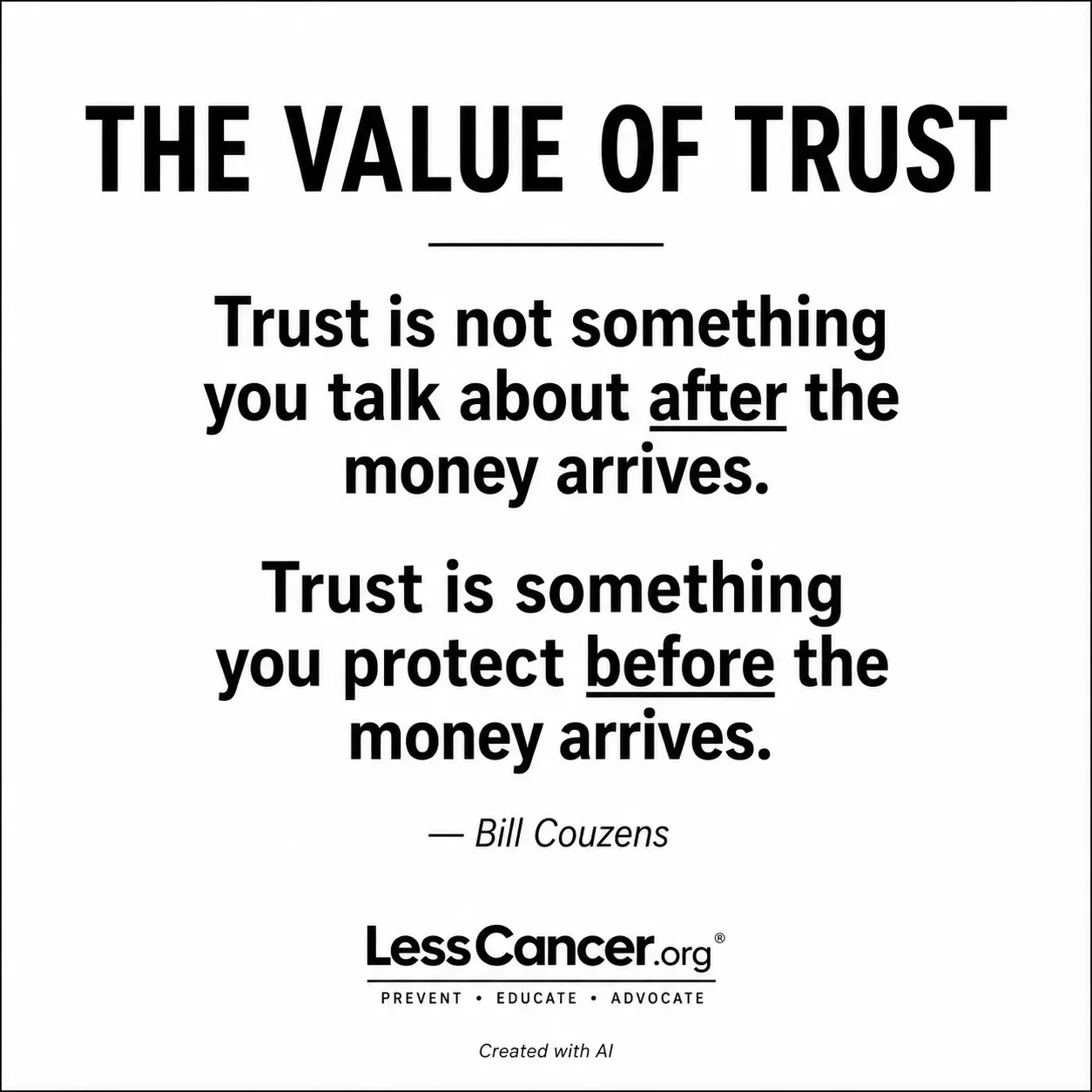
Trust is not something you talk about after the money arrives.
Trust is something you protect before the money arrives.
A budget can be rebuilt.
A program can be redesigned.
A fundraiser can be replaced.
Trust is different.
Once it's lost, it's very difficult to get back.
That's why I continue to return to a simple question:
If the money disappeared tomorrow, would we still say exactly the same thing?
For me, that's the test.